



Procurement Decision Guide: Strategic Selection of Screen Materials
The primary functions of any screen are invariably filtration, dewatering, or protecting downstream equipment. Assuming the product meets these essential functional requirements, what are the differences that distinct screen materials bring?
To assist your procurement decisions, we provide a focused analysis on the differences among three common screen materials—Stainless Steel, Polyester (PET), and Nylon (PA)—from the perspective of mechanical strength, chemical stability, and Total Cost of Ownership (TOC).
The goal in material selection is to effectively balance performance, lifespan, and cost.
These three materials exhibit distinctly different performance profiles under varying operating conditions:
| Screen Material | Key Characteristics and Advantages | Typical Cost Positioning | Application Strength & Lifespan |
|---|---|---|---|
| Stainless Steel | Extremely high mechanical strength and thermal stability, excellent corrosion and abrasion resistance, and highly precise aperture sizing. | Highest (Initial Investment) | Highest (Ideal for high-load, long-term continuous operation) |
| Polyester (PET) | Excellent dimensional stability, moderate chemical resistance, and good elasticity. | Moderate | Moderate (Not suitable for high temperatures or strong acids/alkalis) |
| Nylon (Nylon, PA) | Excellent flexibility and abrasion resistance, high tensile (or break) strength. | Lowest | Moderate to Low (Vulnerable to acidic attack and high temperatures) |
Strategic Advice and Material Selection
- Material Selection for Long-Term, High-Load Environments
For critical applications demanding long-term stable operation, high mechanical strength, extreme temperatures, or chemical stability, your singular choice should be Stainless Steel.- High Temperature/High Pressure: Stainless steel (e.g., SUS304 or SUS316L) is capable of withstanding the extremely high temperatures and pressures that polymer screens cannot, preventing screen deformation or melting.
- Acidic/Corrosive Media: When processing highly acidic, alkaline, or high-chloride media (such as seawater or certain industrial wastewater), SUS316L or higher-grade alloys (e.g., Duplex Steel S32205) are the preferred choice. This ensures the screen is not rapidly corroded or dissolved, thereby guaranteeing filtration accuracy.
- Recommendation: Although the initial purchase cost is higher, in high-load, continuous operation environments, the exceptionally long lifespan and low failure rate of stainless steel deliver the highest long-term Return on Investment.
- Material Selection for Low-Budget or Short-Term Projects
If the project has a limited budget, or if the operating environment is mild and does not have high demands for chemical stability, you can consider Polymer Screens.
| Material | Applicable Scenarios | Conditions to Avoid |
|---|---|---|
| Polyester (PET) | Suitable for moderate temperatures (typically < 120°C), neutral or weakly acidic or alkaline water treatment, food processing, or non-critical filtration. It is more resistant to hydrolysis and has better dimensional stability than nylon. | Strongly alkaline media, high temperature (above 150°C), high abrasion. |
| Nylon (Nylon, PA) | Suitable for short-term, low-abrasion applications or those requiring very high flexibility. It is the option with the lowest initial cost among the three. | All acidic media (highly prone to hydrolysis), high temperature, continuous hot and humid environments. |
| Low-Budget Strategy | These materials have a short replacement cycle, but due to their extremely low initial investment, they are suitable as temporary solutions, for non-critical processes, or for filtering mild media. |
Analysis of Key Factors Affecting the Total Cost of Ownership (TOC) of Screens
As a Procurement Manager, you should not only focus on the Initial Purchase Price but, more importantly, consider the Total Cost of Ownership (TOC)
Total Cost of Ownership = Initial Purchase Cost + Operating Cost + Maintenance & Replacement Cost + Downtime Cost
The following are the key factors influencing TOC:
1. Initial Purchase Cost
| Material | Trend | Explanation |
|---|---|---|
| Stainless Steel | Highest | High raw material costs and high processing complexity (e.g., precision welding). |
| Polyester/Nylon | Lowest | Low raw material costs; standardized production process, low replacement cost. |
2. Maintenance and Replacement Costs
- Screen Lifespan: Stainless steel boasts the longest lifespan, often several, or even dozens, of times longer than polymer screens. This dramatically reduces replacement frequency and associated labor costs. While polymer screens have a low unit price, they may necessitate frequent equipment shutdowns for replacement.
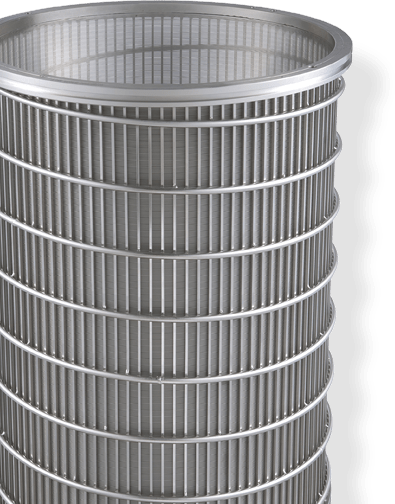
- Clogging Resistance: Stainless steel Wedge Wire screens possess inherent anti-clogging properties due to their V-shaped structure (narrow on the filtration surface, wider inside) and smooth surface finish. Polymer woven meshes face a higher risk of clogging and greater difficulty in cleaning, especially during fine screening applications.
3. Operating and Energy Costs
- Open Area and Pressure Drop: The effective open area of the screen is a key determinant of the energy consumption of the system's pump. Well-designed stainless steel Wedge Wire screens provide an extremely high open area, which minimizes filtration resistance. This, in turn, reduces the electrical energy required for operation. Conversely, if a polymer mesh clogs, the pressure drop can surge rapidly, leading to a significant spike in energy consumption.
4. Failure and Downtime Costs (Most Critical)
- Chemical Corrosion-Induced Failure: Misuse of Nylon in an acidic environment can lead to the screen rapidly disintegrating (hydrolyzing) in a short period. This can result in material loss or severe damage to downstream equipment.
- Mechanical Fatigue-Induced Breakage: In high-intensity vibration or high-pressure applications, the body of a polymer screen may rupture quickly. The cost of emergency repair and subsequent production losses associated with each unexpected shutdown often far exceeds the initial price of the screen itself.
Final Recommendation
For any process deemed critical or corrosive, the choice should be high-quality Stainless Steel (e.g., SUS316L or S32205). For filtration processes that are non-critical, involve mild operating conditions, and are strictly limited by initial cost, Polyester or Nylon may be used.
 +886(4)2682-2061
 Contact Us Now!